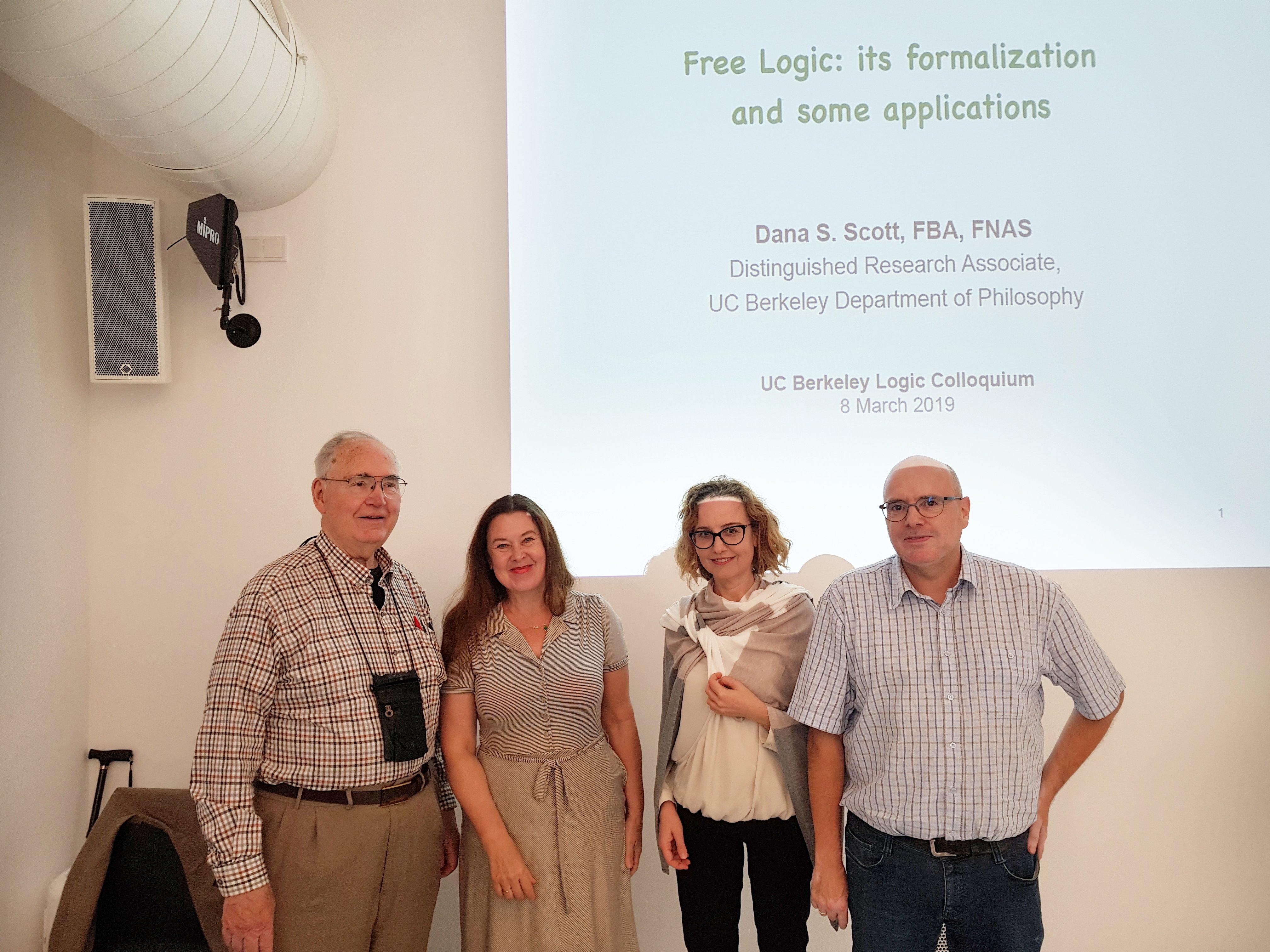

BIOGRAPHY
Dana Scott is American mathematician, logician, and computer scientist who was cowinner of the 1976 A.M. Turing Award, the highest honour in computer science. Scott and the Israeli American mathematician and computer scientist Michael O. Rabin were cited in the award for their early joint paper “Finite Automata and Their Decision Problem,” which introduced the idea of nondeterministic machines to the field of automata theory, and for their subsequent independent work.
Scott’s last position, at Carnegie Mellon, gives some inkling of the remarkable diversity of his academic interests. In addition to contributing his seminal work on automata theory, Scott collaborated in the 1970s with the British computer scientist Christopher Strachey to lay the foundations of the mathematical (or denotational) semantics of computer programming languages. The outgrowth of that work led to Scott’s introduction of domain theory, providing, in particular, mathematical models for the λ-calculus, or lambda calculus (a formal mathematical-logical system invented in 1936 by the American logician Alonzo Church), and many other related theories. Scott was the first editor in chief of Logical Methods in Computer Science, an online open-access journal founded in 2005. (Encyclopedia Britannica, 2019. Available at Link)